Written by Rick Timlick, Blaze Performance
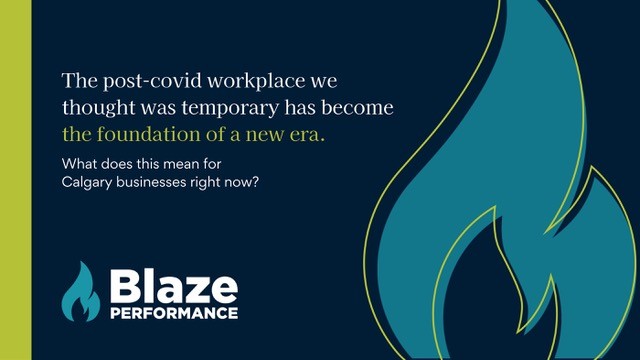
When the pandemic hit in 2020 and the world scrambled to adapt, few of us believed the changes would last. Offices closed, video calls filled our days, and leaders worked overtime to keep teams connected. The mindset was: just get through this until things go back to normal. But here we are, five years later, and there’s no going back: the post-COVID workplace we thought was temporary became the foundation of a new era.
For Calgary’s business community, this isn’t just an interesting observation. It’s a reality that directly affects how we attract talent, keep people engaged, and build organizations that can thrive in a competitive and unpredictable economy.
So what actually stuck, and how can organizations use these lessons to succeed in today’s workplace?
One of the biggest shifts has been flexibility. Remote and hybrid work are no longer considered perks, they are now baseline expectations in jobs where it’s possible. Even organizations that pushed hard for a full office return have had to adopt more adaptive policies. Companies that refuse to evolve aren’t just seen as rigid, they’re losing ground in recruitment and retention. Bottom line is that flexibility has become a business advantage.
The concept and parameters of office culture have changed as well. Before 2020, office culture was often tied to physical spaces like open floor plans, office perks, team events. When those disappeared, culture had to live somewhere else, and it’s manifesting in shared values, daily behaviors, and the ways people connect, regardless of location. For leaders, this means culture can no longer be defined by the physical office space or by perks alone. It must be shaped deliberately and reinforced consistently, or it will grow on its own, and not always in the most opportune direction.
Well-being has also moved from the margins to the centre of business strategy, which is something to celebrate. Leaders used to talk about resilience and burnout in hushed tones or leave it to HR, and now we know that performance collapses when people are exhausted, stressed, or unsupported. Companies that invest in well-being — and not just with programs, but with real conversations and leadership practices — see stronger performance, higher loyalty, and more innovation. In Calgary, where the pace of business can be relentless, well-being is no longer “nice to have.” Addressing mental, physical, and social health within the workplace is a critical, strategic value to staying in the game.
Knowledge sharing is another lesson that stuck — the pandemic revealed how quickly organizational knowledge can become outdated. Teams that developed muscle for rapid knowledge sharing and transparency adapted fastest and hit targets more reliably: treating knowledge as something to share, not a guarded asset. In today’s uncertain markets, that practice of agility is priceless. The flow of information is a precursor to innovation, open communication makes organizations resilient, and silos spur fragility.
And then there’s leadership. The command-and-control approach simply didn’t survive the pandemic, leadership is now about designing conditions for people to succeed, not just managing outputs. Great leaders are defined by their ability to design adaptive cultures and create environments of clarity and trust, regardless of the time zones. And also by being less task managers, and more adaptive architects of culture, accountability, and psychological safety.
So what does this post-COVID workplace mean for Calgary businesses right now? It means taking a hard look at what’s working in your organization and what isn’t. It means asking: what did we learn over the past five years, and how do we want to build going forward?
That might mean redefining your culture in ways that work across remote and in-person contexts. It might mean embedding well-being into the fabric of leadership instead of treating it as an initiative. It might mean breaking down silos to make knowledge flow faster. Or it might mean equipping managers with the tools to lead differently—less control, more clarity, more connection.
None of this happens by accident. It takes intention, leadership investment, and follow-through. But the payoff is real: higher retention, stronger performance, and organizations that are built to last.
And for Calgary in particular, the stakes are high. Our city is diversifying its economy, growing new industries, and competing nationally and globally for talent and investment. The organizations that thrive here will be the ones that treat these changes not as disruptions to survive, but as opportunities to lead.
So my challenge to Calgary’s business leaders is this: don’t aim to “get back” to anything, that post-covid framework is gone. Instead, decide what you want your workplace to be five years from now, and be bold, be intentional, and involve your people in the design. Because the organizations that lean into this moment — openly, honestly, and strategically — won’t just survive this new era, they’ll define it.
To learn more about Blaze Performance, visit: www.blazeperformance.ca.