
Calgary, AB, September 24, 2026 – As Canadian businesses face growing barriers in key international markets, a recent study by Trevor Tombe, Professor of Economics at the University of Calgary, commissioned by the Calgary Chamber of Commerce, finds Canada’s internal trade barriers impose significant costs on the national economy – and that Alberta separation would likely exacerbate these barriers. Tombe’s study shows that approximately 330,000 Alberta jobs – 13 per cent of the provincial workforce – are directly or indirectly supported by exports to other provinces, spanning manufacturing, professional services, wholesale trade, transportation, hospitality and agriculture.
“Internal trade barriers have long plagued our economy, compromised our productivity and prevented us from being our own best customer,” says Deborah Yedlin, President and CEO at the Calgary Chamber of Commerce. “At a time when Canadian businesses are confronting new barriers abroad, reducing barriers between provinces and territories is increasingly important to strengthening Canada’s economic resilience and competitiveness.”
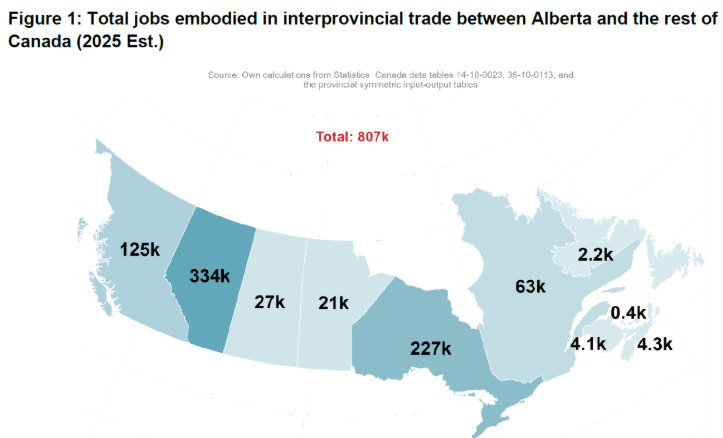
The relationship between Alberta and Canada is mutually beneficial. Trade with Alberta supports an estimated 800,000 jobs elsewhere in Canada, including approximately 230,000 in Ontario and 125,000 in British Columbia. Interprovincial trade involving Alberta also generates approximately $151 billion in income across Canada, including $78 billion in Alberta, $34 billion in Ontario and $21 billion in British Columbia. Next to the United States, Alberta is Ontario’s largest trading partner.
“Alberta’s economy has relied heavily on internal trade, with one-third of Alberta businesses selling goods and services interprovincially and more than half of businesses purchasing goods from other provinces,” says Yedlin. “Separation would result in interprovincial trade becoming international trade – increasing costs, , leading to greater uncertainty around market access, infrastructure, regulation, taxation and investment. The focus must be on strengthening our partnerships with other provinces and territories to create a mutually beneficial – and single – Canadian market.”
Alberta is both a major contributor to and a major beneficiary of the Canadian internal market. This mutual dependence strengthens the case for ambitious reform. It also demonstrates why separation would involve far more than a change in political jurisdiction: It would require Alberta to renegotiate the economic relationships, market access and infrastructure arrangements that currently operate within a shared national framework.
“Alberta’s economic strength is built our ability to trade freely with customers and businesses across Canada,” adds Yedlin. “Our focus should be on removing the obstacles that stand in the way of this trade, not creating new ones. A stronger Canadian market will make Alberta more competitive at home and better positioned to compete globally.”
Quick Facts
Economic estimates drawn from Trevor Tombe, The Economic Implications of Alberta Separation, commissioned by the Calgary Chamber of Commerce
- Interprovincial exports account for about 16 per cent of total provincial income, amounting to $78 billion in income to Alberta workers and businesses in 2025, while international exports account for another 39 per cent, or approximately $390 billion.
- Approximately 330,000 Alberta jobs – 13 per cent of the provincial workforce – are directly or indirectly supported by exports to other provinces, spanning manufacturing, professional services, wholesale trade, transportation, hospitality and agriculture.
- Trade with Alberta supports an estimated 800,000 jobs elsewhere in Canada, including approximately 230,000 in Ontario and 125,000 in British Columbia.
- Interprovincial trade involving Alberta also generates approximately $151 billion in income across Canada, including $78 billion in Alberta, $34 billion in Ontario and $21 billion in British Columbia. Next to the United States, Alberta is Ontario’s largest trading partner.
– 30 –
About the Calgary Chamber of Commerce
The Calgary Chamber exists to empower our business community to advance a prosperous Calgary and Canada. As the convenor and catalyst for a vibrant, inclusive and prosperous business community, the Chamber works to build strength and resilience among its members and position Calgary as a magnet for talent, diversification and opportunity. As an independent, non-profit, non-partisan organization founded in 1891, we build on our history to serve and advocate for businesses of all sizes, in all sectors across the city.
Media opportunities
For media inquiries, please contact: [email protected]