
New to SEO? This beginner-friendly guide explains how Calgary companies can build visibility, earn traffic, win more local business, and compete online with confidence.
Picture a plumbing company in Northwest Calgary. Twenty years in the trade, fair prices, solid reviews. The kind of business you’d happily recommend to a neighbour. There’s just one problem: it doesn’t show up on Google’s first page. For Calgary residents looking online for a local plumber, that company may as well be invisible.
Nearly half of all Google searches look for nearby services, and 76% of those searches visit a local shop within a day because they want a solution right down the street.
Companies that don’t show up in online searches are left out before they even have a chance to compete. Yet, 58% of businesses still don’t actively optimize for local search, and only 30% have a documented local SEO strategy.
SEO has a reputation for being technical and intimidating. And when you eventually need a comprehensive strategy, hiring a Calgary SEO agency is highly effective. But the fundamentals that move the needle for local businesses are very much accessible. Below, we briefly go over how Calgary businesses can improve visibility and start winning search.
SEO starts with the keywords your customers are searching
Most people hear “Search Engine Optimization” (SEO) and immediately think of Google, which is understandable. Google is where the rankings live. But SEO starts much earlier, with understanding what your customers are searching for in the first place.
Marketers call this “search intent,” which is a way to describe what a user wants. When someone types “emergency plumber Calgary” into Google, they need a professional at their door, not a history lesson on water pipes.
Search engines then try to connect the searcher with websites that offer the most relevant solution, which is where keywords come in. Keywords are the exact phrases people type into search engines like Google.
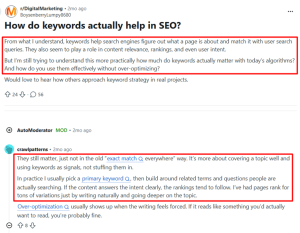
To optimize for keywords, marketers have historically gone overboard by stuffing keywords excessively into their posts, but that only hurts rankings today. The most effective approach is to understand what your keywords convey and write naturally to satisfy that intent. A marketer on Reddit sums it up nicely:
In practice, people actively searching for various services in Calgary would use keywords like:
- “Emergency roofer Calgary”
- “Physiotherapist downtown Calgary”
- “Accountant for small business near me”
- “Emergency plumber Calgary northwest”
- “Local commercial cleaning services”
One common mistake businesses here make is describing themselves the way they talk internally rather than the way customers search. A company may call itself a “residential plumbing systems specialist.” Meanwhile, a homeowner with a flooded basement at midnight types “emergency plumber open now Calgary.”
The good news is you don’t need expensive software to uncover these opportunities. The “People Also Ask” sections in Google’s results alone can reveal dozens of common searches in minutes.
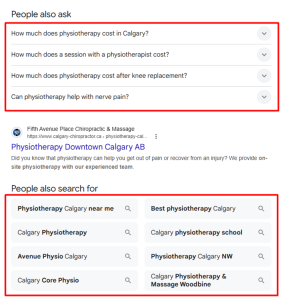
Studying your competitors’ websites can also help you find gaps to optimize for. But you can start applying these fundamentals right now.
Identify your main keywords, then use them naturally and consistently in your page titles, main headings, your website text, blog and social posts, image descriptions, and everywhere else.
Your Google Business profile is your most valuable SEO asset
For most local searches, your Google Business Profile (GBP) shows up before your website does. And all a potential customer sees there is your name, ratings, service hours, a few photos, and a button to call. They make a decision right there, without clicking anything.
According to WhiteSpark’s 2026 Local Search Ranking Factors survey, your GBP is the single most influential factor in where you appear in Google’s Local Pack (32%), which is more than reviews (20%) and more than your website’s on-page signals (15%).
When someone searches for a nearby service, Google often displays a map with three business listings before the traditional search results. Those spots attract a significant share of local clicks because they’re visible, convenient, and packed with information.
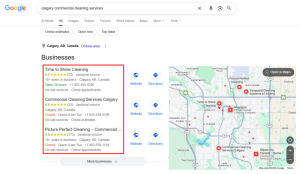
This is why a complete GBP matters so much. At a minimum, your profile should include accurate contact information, business hours, service categories, photos, service areas, and a clear description of what you do.
For Calgary businesses, proximity signals within quadrants (NW, NE, SW, SE) also affect local search behavior and Google Maps rankings. Businesses based solely in Mission can’t show up for searches in Panorama Hills. Clear service area information helps Google understand who you’re trying to serve.
None of this is overly technical. In fact, updating and completing your GBP is often one of the fastest SEO wins available to a local business. Before you worry about advanced SEO tactics, make sure this foundation is solid.
Your website should match the services people search for
Once you know what your customers are searching for, your website needs pages that answer those searches. Small businesses often make the mistake of treating their webpages like digital brochures about their history.
When customers search on Google, they look for immediate answers to two questions: what do you do, and where do you do it? You can capture these buyers by building focused service and location pages for every key service you offer.
Think of each page as an open door for customers. A website with dedicated pages for roof repair, roof replacement, and emergency roofing gives Google more opportunities to match your business with relevant searches than a website with a one generic services page. Here’s an example from Calgary Elite Roofing:
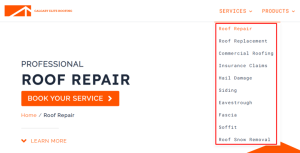
The same logic applies to locations. If you serve multiple areas, it helps to clearly explain where you work and what services you provide there. This doesn’t mean building a hundred thin pages but instead creating a page for each core service you provide.
Your business Name, Address, and Phone number (NAP) should also appear consistently on every page, and they should match exactly what’s listed on your Google Business Profile and every other directory online.
And while you’re at it, check how your site works on a phone. Nearly 60% of searches happen on mobile. If someone has to wait for more than 5 seconds for your site to load or pinch and zoom to read your service area, chances are you’ve lost them.
Google trusts businesses that other people vouch for
Your website is only a small part of the search equation. Google also looks for signals that other people use and recommend your business.
Reviews are one of the clearest examples. A steady stream of glowing recent reviews tells Google that your business is active and serving real customers. Responding to those reviews helps too, as it shows engagement and builds trust with future customers. Here’s an example from MM Family & Divorce Lawyers:
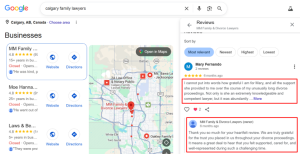
After you finish a job, ask your customers if they’d be willing to leave a review. Send a link to make it easy, and most happy customers are glad to help.
Getting mentions from other credible websites is another important vote of confidence that helps Google assess your business. In SEO, these are called backlinks. A recommendation (with a link) from a trusted local website works a lot like a referral in the real world.
Not all referrals carry the same weight, though. Mentions from a respected local organization and industry publication often mean more than dozens of low-quality directory listings. In practice:
- If the Calgary Chamber of Commerce links to your business, Google notices.
- If Avenue Magazine or the Calgary Herald mentions you in a roundup, that carries weight.
- If a neighborhood blog in Marda Loop or a sponsorship page for a local hockey team links to your business, Google knows you’re part of the community.
These sources link to local businesses all the time. You can sponsor something, speak at an event, or get quoted in an article to earn these mentions.
Your business name, address, and phone number should appear the same way everywhere, whether that’s Google, Yelp, Yellow Pages, or an industry directory. Taken together, these signals help Google answer an important question: “Can this business be trusted?”
The more evidence it finds, the more confident it becomes about showing your business to potential customers.
Nofollow vs. Dofollow Backlinks: both have SEO value
Not all backlinks send the same signals to Google. Most standard links are commonly called “dofollow” links, meaning search engines can use them when evaluating the authority and relevance of the page being linked to. These links generally pass the strongest and most direct link equity.
A nofollow link includes an attribute that tells search engines not to treat the link as a standard followed link. That doesn’t mean the link is worthless. Google now treats nofollow as a hint, meaning these links can still contribute to SEO signals and may pass some link equity. They can also send referral traffic, reinforce your business’s connection to a specific location or industry, and create a more natural backlink profile.
The Calgary Chamber of Commerce is a good local example. Links within Chamber business listings are nofollow, so they may not carry as much direct ranking weight as a followed editorial backlink. But having your business listed and linked from a trusted Calgary organization is still worthwhile from an SEO perspective.
The goal shouldn’t be to build only dofollow links. A healthy backlink profile includes a mix of links and mentions from credible websites. Relevance, trust, and the quality of the website linking to you matter more than simply avoiding every nofollow opportunity.
SEO fundamentals done consistently outperforms any shortcut

SEO isn’t an attempt to game an algorithm or find a quick shortcut. It’s essentially the consistent practice of helping search engines like Google understand who you are, what you do, and which customers you’re trying to reach.
The reality is, search takes time. Rankings rarely change overnight, but small improvements tend to compound. A better Google Business Profile, stronger service pages, solid review strategy, and clearer information on your website all add up.
Most Calgary businesses aren’t doing all of these consistently, which is an opportunity in itself. The companies that win search are those that start before they need immediate results and stick with the fundamentals long enough for them to pay off.
This article was prepared for the Calgary Chamber by Spacebar Collective.