Read report
Read explainer
Read open letter
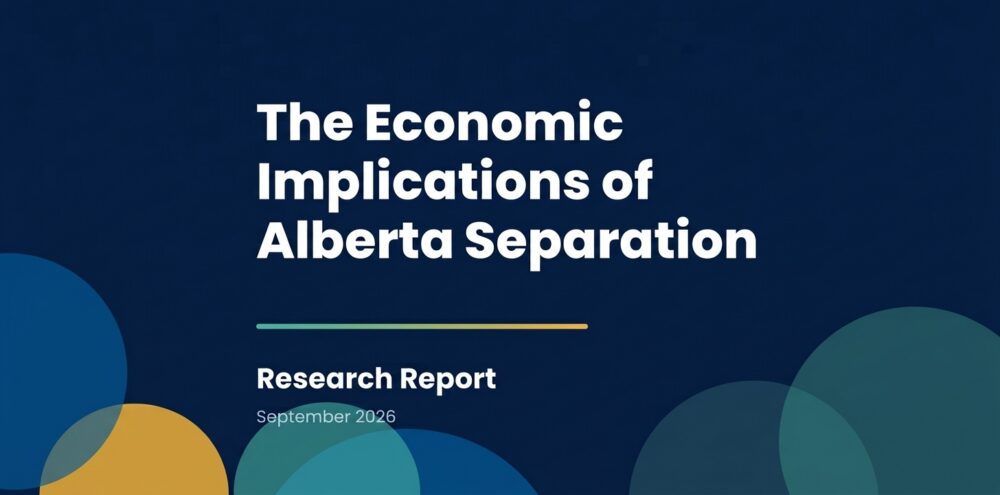
Calgary, AB, September 29, 2026 – A new report by University of Calgary economist Trevor Tombe, commissioned by the Calgary Chamber of Commerce, examines the potential economic implications of Alberta separating from Canada. Expanding on early findings released in June 2026, this report reveals Alberta is more trade exposed than any other province, would experience significant flight of both capital and labour, putting considerable pressure on public finances and therefore taxation levels.
“This report puts real data to the concerns we’ve been hearing in the business community for months,” says Deborah Yedlin, President and CEO at the Calgary Chamber of Commerce. “The evidence is clear: separation would leave Alberta with a smaller economy, fewer workers, less investment and weaker public finances. There is no windfall waiting on the other side – only a bill Alberta business and communities would have to pay.”
TRADE EXPOSURE
Alberta is in a position of considerable strength, but our prosperity depends heavily on connections beyond our borders. Alberta is the most trade-exposed jurisdiction in the country, both to interprovincial and international trade, and relies heavily on foreign capital. Foreign multinational investment averages more than $3,400 per Albertan, compared with roughly $1,800 nationally, with multinationals responsible for nearly $500B in investment and 650,000 jobs per year in Alberta.
“Capital has options,” says Yedlin. “A multinational company deciding where to build its next facility, expand operations or deploy new capital can choose among many jurisdictions. It also has to compete for investment dollars within the company itself. Changes to Alberta’s trade relationships, regulatory environment, borrowing costs or access to markets could therefore change its attractiveness relative to other places.”
Drawing on the Brexit experience in the United Kingdom, the report estimates separation would raise the cost of trading with both the rest of Canada and the world by five to eight per cent, driving losses in output and workers. In Calgary, more than 360,000 jobs – over 36 per cent of total employment – depend on exports, across professional, scientific and technical services, transportation and warehousing, manufacturing, wholesale and retail trade, and tourism. If the city’s losses are proportional to the province’s, higher trade costs would mean 44,000 to 69,000 fewer jobs in Calgary.
LABOUR
With 49 per cent of Albertans born outside the province, Alberta relies heavily on the movement of people within the country; a new national border would make that movement more complex and could reduce Alberta’s ability to attract new workers. New Albertans are also responsible for Alberta being the youngest and most highly educated province, with 80 per cent of people moving to Alberta from other provinces being under 40 – bringing skills and education with them. In fact, Alberta has gained nearly $120 billion in taxpayer-funded education embodied in workers educated elsewhere – approximately one-quarter of provincial GDP.
“Alberta has benefitted directly from the inflow of labour,” says Yedlin. “Our province has successfully attracted talent from international and interprovincial markets – arriving with education other governments have paid for, are on average younger and therefore less burdensome on the healthcare system. They have filled labour shortages yielding economic growth that would not have been possible without this influx of workers.”
PUBLIC FINANCES
On public finances, the report finds Ottawa collected about $19 billion more in Alberta than it spent in the province in 2024, but a separate Alberta would not inherit that surplus. Spending would rise, as the province would have to take on functions Ottawa now performs – including nearly $10 billion a year to meet the NATO defence standard and approximately $8 billion more to run federal operations – while revenues would fall by more than $10 billion because of a smaller economy.
Closing the resulting gap would require a sales tax of about eight per cent on top of the five points inherited from Ottawa, a 10-point increase in the corporate income tax rate, or a cut of about 40 per cent to the federal transfers that reach roughly 400,000 Alberta families through the Canada Child Benefit and about 630,000 Albertans through Old Age Security.
“Low taxes, quality public services, access to markets, investment and talent reinforce one another,” explains Yedlin. “Today’s report points to a feedback loop in which weaker growth reduces revenues, fiscal pressures lead to higher taxes or reduced services, and those changes further affect investment and labour attraction. Ultimately, separation would put Alberta’s advantages at risk and undermine the predictable, business-friendly environment that defines our economy.”
Quick Facts
The Economic Implications of Alberta Separation by Trevor Tombe, commissioned by the Calgary Chamber of Commerce (September 2026)
Trade exposure
- More than 360,000 Calgary jobs – over 36% of employment – depend on exports to another province or country.
- A 5% increase in trade costs would mean approximately 44,000 fewer jobs in Calgary, and an 8% increase would mean about 69,000 fewer jobs.
- Foreign multinational investment averages more than $3,400 per Albertan, compared with roughly $1,800 nationally.
- Over the past decade, foreign multinationals invested $152B in Alberta and Canadian multinationals another $314B – accounting for 650,000 jobs per year total.
Labour
- Alberta relies on international and interprovincial migration for labour and taxation, with 26 percent of Albertans born outside Canada and another 23 percent were born elsewhere in Canada.
- Approximately 1.1 million Albertans were born elsewhere in the country, and about 80% of people moving to Alberta from another province are under 40. Alberta has gained nearly $120 billion in taxpayer-funded education embodied in workers educated elsewhere – approximately one-quarter of provincial GDP.
- Nearly 75,000 people living in other provinces worked in Alberta in a single year, with construction and resource industries especially reliant on these interjurisdictional workers.
Public finances
- Ottawa currently collects around $19 billion more from Alberta than it spent in the province. A separate Alberta would instead face an annual shortfall of about $9 billion. Closing this gap would require a 10% increase in corporate income tax or an 8% provincial sales tax.
- Meeting the NATO defence standard would cost a separate Alberta nearly $10 billion a year and running federal operations approximately $8 billion more than Ottawa spends on them in the province today.
– 30 –
About The Economic Implications of Alberta Separatism
Alberta’s economic strength is built on access to markets, investment, infrastructure and talent across Canada and around the world. Commissioned by the Calgary Chamber of Commerce and prepared by economist Trevor Tombe, this report examines how separation could affect trade, investment, labour mobility and public finances, helping Albertans better understand the economic implications and what is at stake for the province’s future prosperity.
About the Calgary Chamber of Commerce
The Calgary Chamber exists to empower our business community to advance a prosperous Calgary and Canada. As the convenor and catalyst for a vibrant, inclusive and prosperous business community, the Chamber works to build strength and resilience among our members and position Calgary as a magnet for talent, diversification and opportunity. As an independent, non-profit, non-partisan organization founded in 1891, we build on our history to serve and advocate for businesses of all sizes, in all sectors across the city.
Media opportunities
For media inquiries, please contact: [email protected]