Alberta enters the separation debate from a position of considerable strength. Alongside its significant natural resource endowment, the province has a skilled and growing workforce, competitive tax environment, strong investment and access to customers across Canada and around the world.
But Alberta’s prosperity also depends heavily on its connections beyond its borders. Alberta companies can sell across provincial borders without crossing an international boundary and can invest capital across Canada. Workers can move between provinces without work permits or separate immigration systems.
A new economic impact assessment prepared for the Calgary Chamber of Commerce by University of Calgary economist Trevor Tombe examines what could happen if separation made those connections more difficult, costly or uncertain.
The analysis does not assume that trade, investment or migration would stop. Instead, it looks at what happens when a province that is highly connected to the rest of Canada becomes a separate country, and the economic costs associated with those connections becoming harder to maintain.
The findings suggest those changes could affect Alberta through several interconnected channels, including trade, investment, labour mobility and public finances.
Alberta’s economic advantage is built on access
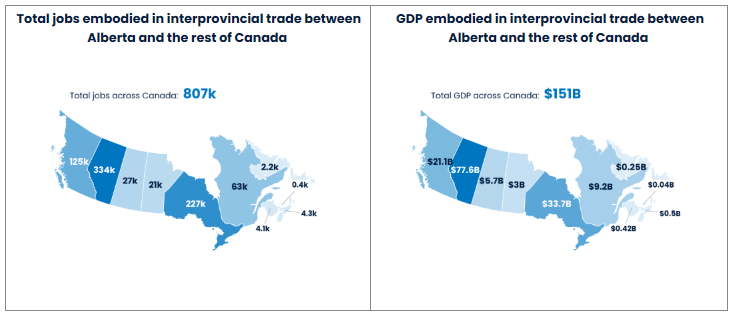
Alberta is one of Canada’s most trade-dependent economies. Nearly one in three Alberta workers – roughly 900,000 people – works in a sector with significant exposure to trade with other provinces or countries. Exports to the rest of Canada support approximately 334,000 Alberta jobs, while international exports support more than 450,000.
That exposure reaches far beyond oil and gas.
Exports support more than 110,000 manufacturing jobs, roughly 140,000 jobs across finance, real estate and professional services, about 65,000 tourism-related jobs and 31,000 agriculture jobs. Even excluding oil and gas, international exports account for approximately 15 per cent of Alberta’s total income.
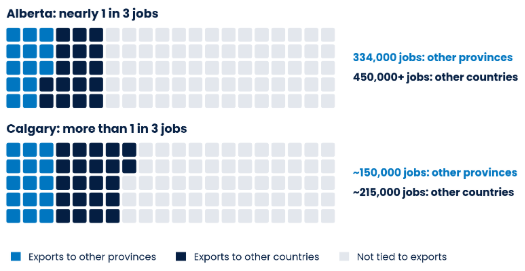
Calgary is even more exposed. More than 360,000 Calgary jobs – over 36 per cent of employment in the city – depend on exports to another province or country. Nearly 150,000 are connected to interprovincial exports and almost 215,000 to international exports.
Jobs embodied in exports, Alberta and Calgary
Separation would not mean those relationships disappear, but it would turn today’s provincial boundary into an international border.
That could introduce new costs through customs procedures, different regulations and standards, and other requirements that do not exist today. An independent Alberta also could not assume that Canada’s existing trade agreements would automatically continue to apply, as future access would depend on agreements reached with Canada and other trading partners.
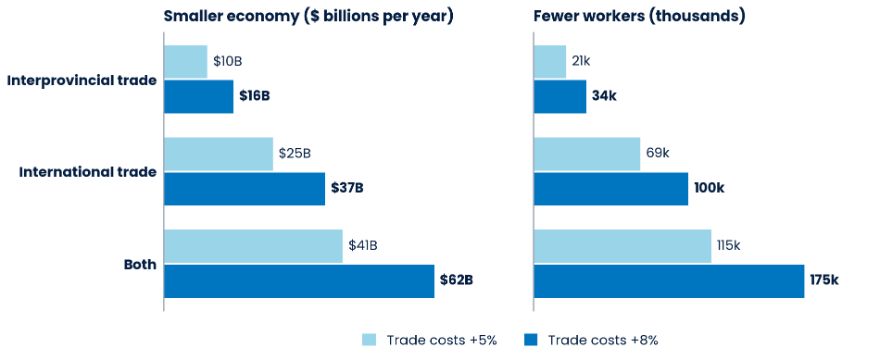
Tombe models trade-cost increases of between five and eight per cent, informed by evidence from the United Kingdom following Brexit. These are scenarios, not predictions, but they illustrate how relatively modest increase in trade costs can ripple through an economy that depends heavily on access to outside markets.
For Calgary specifically, if employment changed proportionately with the provincial modelling, the analysis implies roughly 44,000 fewer jobs under the five per cent scenario and about 69,000 fewer under the eight per cent scenario.
Investment and talent can move
Alberta’s economic success also depends on its ability to attract capital and people.
The province attracts unusually high levels of mobile investment. Foreign multinational investment averages more than $3,400 per Albertan, compared with roughly $1,800 nationally. Over the past decade, foreign multinationals have invested $152 billion in Alberta, and Canadian multinationals another $314 billion. Together, those firms have accounted for roughly 650,000 jobs per year on average.
But capital has options.
A multinational company deciding where to build its next facility, expand operations or deploy new capital can choose among many jurisdictions. Changes to Alberta’s trade relationships, regulatory environment, or access to markets would change the cost of investment as risk premiums would increase relative to other jurisdictions.
Uncertainty itself can also affect investment. Looking at the United Kingdom’s experience after Brexit, Tombe estimates that a comparable decline in Alberta could mean $10 billion to $15 billion in foregone investment in a single year – as much as $3,000 per Albertan. Not only does this mean our resource development opportunities could be compromised, it would likely lead to a drop in productivity because of decreased investment in machinery, equipment and technology.
People can make the same kinds of choices.
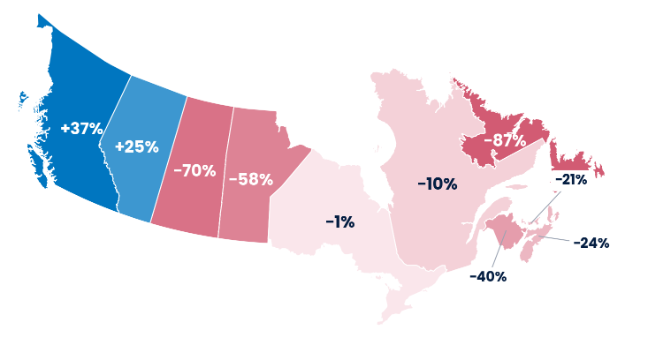
Forty-nine percent of Albertans were born outside the province. Of that, approximately 1.1 million Albertans were born elsewhere in Canada, and about 80 per cent of people moving to Alberta from another province are under 40. They strengthen the labour force and tax base while bringing skills and education often funded by taxpayers elsewhere. Tombe estimates Alberta has gained nearly $120 billion in taxpayer-funded education embodied in workers educated in other provinces, or roughly one-quarter of provincial GDP.
Net value of taxpayer-funded education embodied within interprovincial migration of Canadian-born individuals, as a share of GDP
International immigration is another important source of labour and tax revenue for Alberta. Immigrants under 40 paid roughly $1.1 billion in provincial taxes in 2026; after accounting for provincial family programs, workers’ compensation and social assistance, their net contribution was just under $1 billion. Across all ages, immigrants contributed more than $4.1 billion in provincial taxes.
Businesses also rely directly on workers who live elsewhere. In 2022, nearly 75,000 people living in another province worked in Alberta, with construction and resource industries particularly reliant on these interjurisdictional workers. Today, those workers can move across provincial borders without work permits or separate immigration systems.
Investment and talent are both mobile. Alberta has benefited by being an attractive place for both; separation could weaken that advantage by making the province more complex, costly or uncertain relative to competing jurisdictions.
Separation would also put pressure on Alberta’s public finances
The economic effects of separation would ultimately show up in government finances and in the taxes and services Albertans rely on.
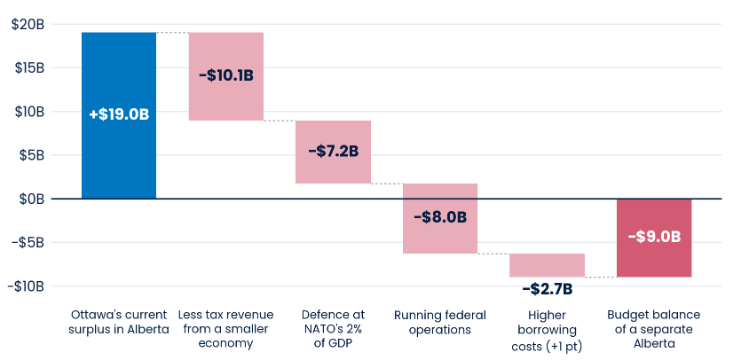
In 2024, Ottawa collected approximately $73 billion in Alberta and spent about $54 billion, meaning Alberta contributed roughly $19 billion more to the federal government than was spent in the province. That difference is often central to arguments about the fiscal case for separation. Tombe’s analysis, however, shows why it cannot be viewed in isolation.
A separate Alberta would have to replace functions that are currently provided federally, including defence, border services, foreign affairs and other national institutions. It would likely assume a share of federal debt. And if separation made Alberta’s economy smaller, governments would also collect less income and consumption tax revenue.
Under Tombe’s illustrative assumptions, those changes would turn the apparent $19 billion surplus into an approximately $9 billion annual shortfall – a fiscal swing of roughly $28 billion.
Different assumptions would produce different results, and the report does not attempt to predict every decision a future independent Alberta government might make. But the analysis illustrates the scale of the adjustment that could be required.
Closing a $9 billion gap could mean higher taxes, lower spending, greater borrowing or a combination of all three. To show the magnitude, Tombe estimates that closing the gap entirely through one measure could require an additional sales tax of about eight percentage points on top of the five per cent currently collected federally, or an increase of roughly 10 percentage points in Alberta’s corporate income tax rate. Alternatively, spending equivalent to about 40 per cent of current federal transfers to people and businesses would have to be eliminated.
The potential effect of separation on Alberta’s fiscal balance
Those pressures would affect households as well as businesses.
Federal transfers currently support a large number of Albertans, including roughly 400,000 families receiving the Canada Child Benefit and about 630,000 people receiving Old Age Security. In Calgary, federal transfers across all programs may total approximately $7 billion flowing to roughly 600,000 families.
The question is therefore not simply whether Alberta sends more money to Ottawa than it receives today. It is what it would cost Alberta to replace what Canada currently provides, while maintaining a competitive economy and tax base.
What is at stake
Alberta’s economic advantages reinforce one another.
Access to markets supports jobs and income. A predictable investment climate attracts labour. Labour mobility gives businesses access to workers. A strong economy generates the revenues needed to fund public services. Competitive taxes and quality services, in turn, help attract the next generation of investment and talent.
Tombe’s analysis shows how separation could put pressure on several of those advantages at the same time.
These estimates are scenarios and orders of magnitude, not forecasts. The precise effects would depend on negotiations, future trade arrangements, government policy and many other factors that cannot be known today. But the scale of Alberta’s existing connections to the rest of Canada and the world is clear. Understanding what those connections contribute – and what could change if a provincial border became a national one – is essential to understanding the economic implications of separation.
About The Economic Implications of Alberta Separatism
Alberta’s economic strength is built on access to markets, investment, infrastructure and talent across Canada and around the world. Commissioned by the Calgary Chamber of Commerce and prepared by economist Trevor Tombe, this report examines how separation could affect trade, investment, labour mobility and public finances, helping Albertans better understand the economic implications and what is at stake for the province’s future prosperity.
For the full report, including all the figures referenced in the above explainer, please visit www.calgarychamber.com/referendum.
About the Calgary Chamber of Commerce
The Calgary Chamber exists to empower our business community to advance a prosperous Calgary and Canada. As the convenor and catalyst for a vibrant, inclusive and prosperous business community, the Chamber works to build strength and resilience among our members and position Calgary as a magnet for talent, diversification and opportunity. As an independent, non-profit, non-partisan organization founded in 1891, we build on our history to serve and advocate for businesses of all sizes, in all sectors across the city.