
For highlights of the research results, click here.
To read our press release, click here.
Alberta’s separation debate is taking place at a time of significant economic uncertainty in Canada. To better understand the potential implications of Alberta secession on the economy and the business community, the Calgary Chamber of Commerce commissioned two independent studies. Probe Research surveyed Chamber members to understand the implications of the separation question on their businesses, and University of Calgary economist Trevor Tombe modelled the potential economic impact of Alberta secession. Together, these findings tell a consistent story.
The results point to growing concern within Calgary’s business community about the economic implications of a potential separation process. 91 per cent of surveyed Chamber members reported they are following the referendum discussion closely, underscoring the importance of understanding the potential impacts on Alberta businesses, workers and the broader economy.
Uncertainty is already affecting business decisions
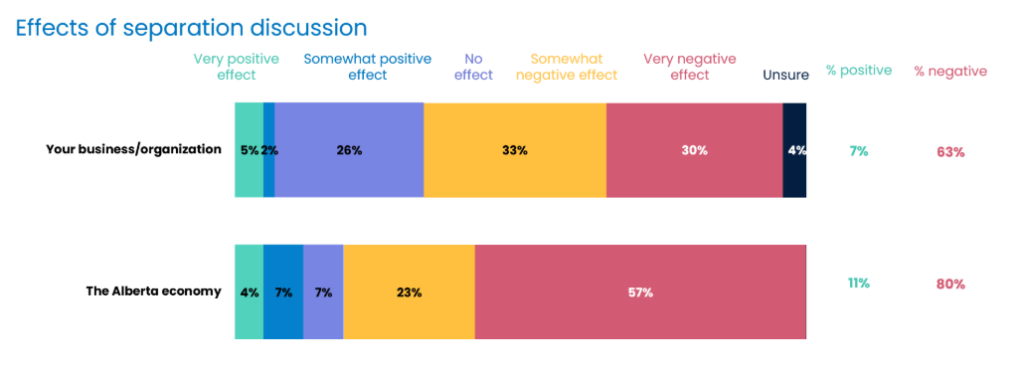
Business investment depends on confidence and predictability. Survey respondents report that the current separation discussion is already creating uncertainty, with 80 per cent saying the debate is having a negative effect on Alberta’s economy and 63 per cent saying it is negatively affecting their own organization. Nearly one in five businesses report they are already slowing expansion plans in Alberta, while 15 per cent are actively exploring relocating to other provinces. Notably, 74 per cent of members see no tangible benefits of separating from Canada.
The economic analysis estimates that Alberta could forgo between $10 billion and $15 billion in investment in 2026 alone if investment levels decline similarly to those experienced following Brexit. Reduced investment means fewer projects moving forward, less capital available for growth and fewer opportunities to create jobs and expand economic activity.
Alberta’s prosperity depends on trade
Alberta’s economy is deeply integrated with both Canadian and global markets. Approximately one in three Alberta workers are employed in sectors exposed to trade with other provinces and countries. Interprovincial exports alone support approximately 330,000 jobs and generated $78 billion in income in 2025, roughly 16 cents of every dollar earned in the province. International exports support more than 450,000 jobs and accounted for about 39 per cent of total provincial income, or approximately $390 billion, in 2025.
Economic modelling shows that if separation increased trade costs by eight per cent, similar to the impact experienced by the United Kingdom following Brexit, Alberta’s economy could shrink by approximately $62 billion annually.
Jobs and talent are at risk
Economic growth, investment and trade ultimately support jobs. The analysis finds that an 8 per cent increase in trade costs could reduce Alberta’s workforce by approximately 175,000 workers.

Business leaders are already concerned about workforce implications of separation. Nearly half of survey respondents say they and their business are likely to move to another province if Albertans vote to begin the formal separation process.
Chamber member respondents were clear that economic stability, market access and investment certainty matter. Together, the survey findings and economic analysis suggest that preserving Alberta’s connections to Canadian and global markets will remain an important foundation for long-term growth and prosperity.
About the Calgary Chamber of Commerce
The Calgary Chamber exists to empower our business community to advance a prosperous Calgary and Canada. As the convenor and catalyst for a vibrant, inclusive and prosperous business community, the Chamber works to build strength and resilience among our members and position Calgary as a magnet for talent, diversification and opportunity. As an independent, non-profit, non-partisan organization founded in 1891, we build on our history to serve and advocate for businesses of all sizes, in all sectors across the city.
Survey methodology
Probe Research conducted an online survey of 137 Chamber members June 8 to 22, 2026. All members were sent an email with a secure link to the survey, with multiple reminders sent to those who had yet to complete it. Respondents were broadly representative of the membership in terms of company size, and no weighting was applied to the results. As an online survey is a sample of convenience, no margin of error can be ascribed. However, a random and representative sample of 137 members would have a margin of error of ± 8.1 percentage points, 19 times out of 20.