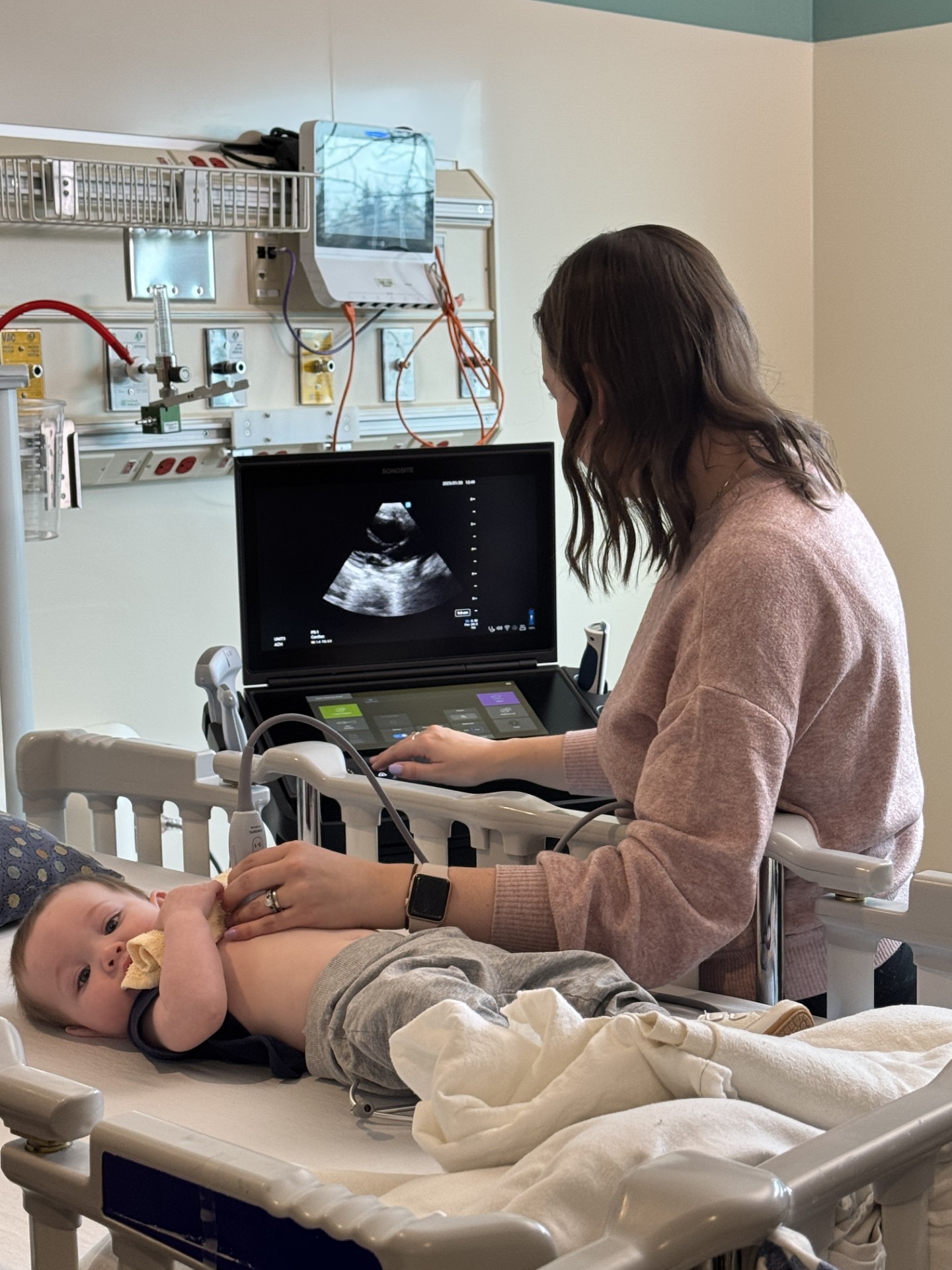
Dr. Jackie Harrison takes a look at Nash’s heart at the Alberta Children’s Hospital using point-of-care ultrasound.
This blog was submitted by the Alberta Children’s Hospital.
Calgary is a city known for innovation, entrepreneurship and community leadership. Those strengths are helping drive progress in an area that matters to every family and every community: child health.
At the Alberta Children’s Hospital, that leadership is helping transform pediatric care through made-in-Calgary innovation, giving care teams better tools, faster answers and new ways to improve outcomes for children when every minute matters.
That progress does not happen in isolation. Through partnerships with the Alberta Children’s Hospital Foundation, Calgary’s business community is helping advance child health in meaningful ways — from corporate sponsorships and employer fundraising to cause marketing and other collaborative initiatives that support innovation, care and training.
For families, the impact of that support can be profound. Laura Klatzel knows firsthand how quickly everything can change.
What was supposed to be a quiet morning at home with her newborn quickly became a life-or-death emergency. Twelve-day-old Nash was fussy and refusing to feed, and when Laura noticed his lips looked slightly blue, she called 911 for help.
Nash was rushed to the Alberta Children’s Hospital, where specialists used point-of-care ultrasound to examine his heart. The real-time images revealed that Nash’s heart was beating dangerously fast and not pumping effectively, putting him at risk of cardiac arrest.
Until recently, ultrasound technology was largely confined to the Diagnostic Imaging department. Today, point-of-care ultrasound is increasingly being used right at the bedside, allowing clinicians to assess and intervene faster. It is transforming pediatric care in ways that are both life-saving and comforting for families.
For example, experts can quickly examine a child’s heart, lungs or abdomen to diagnose serious conditions. Ultrasound can also guide difficult IV insertions and help deliver nerve blocks that reduce pain from broken bones — often avoiding the need for sedation.
Thanks to donor support, portable ultrasound machines are now in use throughout the hospital, helping teams deliver faster, gentler care to children every day.
“With strong support from our Diagnostic Imaging colleagues, clinicians in many specialties are finding innovative ways to use ultrasound to assess, diagnose and treat children. In many ways, it’s becoming the modern-day stethoscope,” said Dr. Mark Bromley, a Pediatric Emergency Medicine physician and KidSONO Co-Director.
Helping drive this rapid expansion is KidSONO — a first-in-Canada training platform developed by physicians at the Alberta Children’s Hospital and funded through philanthropy. More than a training program, it is Calgary-made innovative training that is equipping doctors, nurses and respiratory therapists with the skills to use point-of-care ultrasound in pediatric care and helping establish Calgary as a national leader in pediatric ultrasound education.
KidSONO is now being shared with children’s hospitals across Canada, helping train pediatric teams nationwide and advancing ultrasound care in pediatrics across the country. It is a powerful example of how investments made by Calgary’s community can do more than support local families in moments of crisis — they can help scale ideas that influence healthcare innovation far beyond city limits.
For Nash, having that technology available in such a critical moment saved his life.
His condition continued to deteriorate. Doctors needed to place him on Extracorporeal Life Support (ECLS), a form of heart-lung bypass that allows the body time to rest and recover.
But as Nash was being connected to the ECLS system, his heart stopped. While the team performed chest compressions, ultrasound helped the surgeon guide the cannula — the tube connecting him to the life-support machine — safely into his neck vessels. This vital visualization allowed specialists to work quickly and precisely, even during active resuscitation and buy him the time he desperately needed.
Nash was diagnosed with supraventricular tachycardia, a fast, erratic heart rhythm that can cause the heart to fail if not treated quickly. With rapid intervention, advanced support including ECLS, and the training and bedside ultrasound tools to guide his care, Nash survived without permanent brain damage — a remarkable outcome after such a critical event.
“Had this happened to us anywhere other than the Alberta Children’s Hospital, the outcome of Nash’s story would have been very different,” said Laura.
Today, Nash is a happy, thriving 20-month-old whose condition is well managed with medication. He is growing, laughing and reaching his milestones — a powerful reminder that innovation in healthcare is about more than technology alone.
It’s about what becomes possible when a city comes together to invest in children’s health — and when business and community partners help move innovation from idea to real impact for real kids and families.
To learn more about the Alberta Children’s Hospital Foundation, or to explore different ways your organization can get involved, go to https://www.childrenshospital.ab.ca/ways-to-help/partner/